
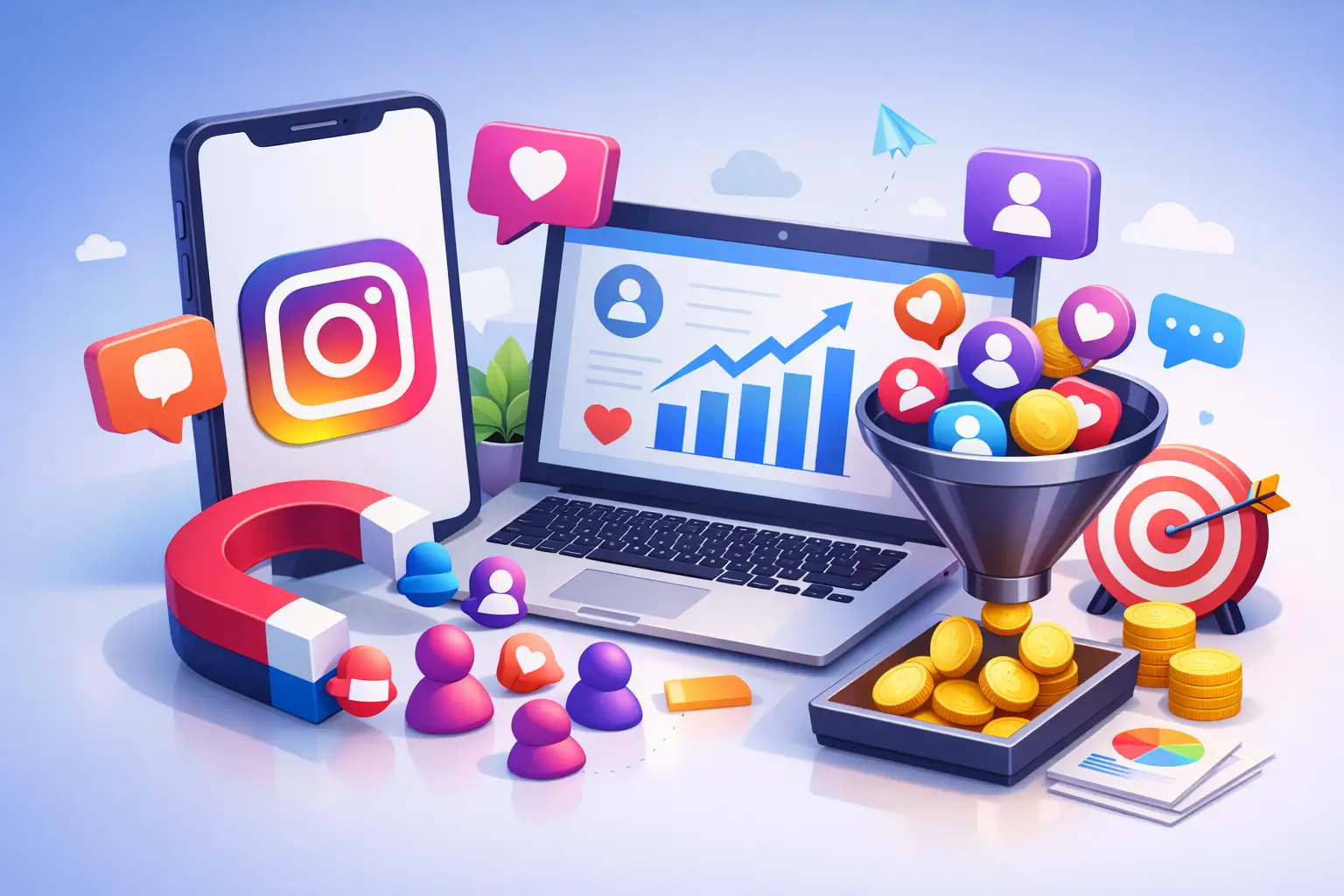
Posting three times a week and waiting for inbound DMs is not a lead generation strategy. It is content roulette. If you want to know how to use Instagram for lead generation, the fastest path is to stop treating the platform like a branding-only channel and start using it like a prospecting database.
Instagram holds buying signals in plain sight. Followers, post likers, commenters, hashtag participants, location-based users, and competitor audiences all tell you who is paying attention to a market. That matters because attention is usually easier to find than intent in cold outreach. The goal is to identify the right audience, segment it, and move those prospects into a direct response workflow you can actually measure.
How to use Instagram for lead generation without wasting time
Most businesses fail on Instagram because they optimize for reach instead of revenue. Reach looks good on a dashboard, but it does not always produce pipeline. Lead generation works better when you define the customer first, then work backward into the Instagram audiences most likely to match that profile.
Start with a simple question: who already attracts your buyers? If you sell to fitness coaches, look at coach educators, software tools for trainers, niche influencers, and relevant gym brands. If you run an agency for dentists, competitor agencies, dental consultants, conference pages, and dental lab brands are stronger sources than broad hashtags like #businessowner.
This is where Instagram becomes useful. You are not guessing who might care. You are identifying users who have already raised their hand by following, liking, commenting, or showing up in a niche community.
Pick one audience source first
You do not need ten targeting angles on day one. You need one that is specific enough to produce quality leads. In practice, the best starting points are competitor followers, users engaging with niche creator accounts, and people posting under industry-specific hashtags.
Competitor followers work because the market is already educated. Hashtag participants work because they reveal active interest. Engaged users often perform best because they are demonstrating current attention, not passive follows from two years ago.
The trade-off is volume versus precision. Broad sources give you more names but weaker fit. Narrow sources give you fewer leads but usually better reply rates. For most small businesses, precision wins.
Build a lead generation workflow around intent
If you want Instagram to produce sales opportunities, the workflow matters more than the content calendar. A practical system has four stages: source the right audience, qualify it, extract usable contact data where legally appropriate, and launch outreach with a relevant offer.
That sounds straightforward because it is. The hard part is discipline. Too many teams dump thousands of contacts into one generic campaign and then decide the channel does not work. Bad targeting and lazy messaging are usually the issue.
Step 1: Define what a qualified lead looks like
Before you collect anything, create a filter. Industry, location, business size, creator type, role, and likely budget all matter. A wedding photographer in Miami is not the same lead as a national bridal retailer. A solo coach is not the same as a SaaS company with a sales team.
Your definition does not need to be complicated. It just needs to be commercial. Who can buy, who has the problem you solve, and who is reachable with a clear offer?
Step 2: Source audiences from real market activity
The best Instagram lead pools usually come from five places: followers of relevant accounts, users who engage with posts in your niche, hashtag communities, location-based audiences, and the followings of ideal prospects.
Each source has a different use case. Location targeting works well for local services, real estate, events, gyms, clinics, and restaurants. Hashtag targeting fits creators, eCommerce, coaches, and trend-driven categories. Competitor audiences are strong when your market already understands the problem you solve.
For outbound sales teams, this matters because the source often shapes the message. A prospect found through a hashtag may respond to trend-based positioning. A follower of a competitor may respond better to differentiation or a stronger offer.
Step 3: Segment before you contact anyone
Segmentation is where ROI gets made. Split audiences by source, niche, geography, and likely pain point. If you are selling email marketing to Shopify brands, separate skincare stores from fashion stores. If you help local businesses, split by city. If you serve coaches, separate business coaches from fitness coaches.
When you segment properly, your messaging becomes sharper without being longer. That improves replies and reduces wasted sends.
How to use Instagram for lead generation with outbound outreach
Instagram is excellent for finding prospects, but discovery alone does not create revenue. The next move is direct outreach. That can mean email, paid audience activation, or a mix of both depending on your sales cycle.
For most B2B and service-based offers, email is the cleanest next step because it gives you more room to personalize, track replies, and run follow-ups. For eCommerce or lower-ticket offers, exporting audiences into paid media can also work if you want to warm them with ads before making a direct pitch.
Write messages that match the audience source
Cold outreach should never feel cold if the targeting is tight. That starts with relevance. Mentioning a niche, audience type, or visible business context is often enough. You do not need fake personalization or paragraphs of flattery.
A simple structure works best: who you help, the result you produce, and why you are reaching out now. Keep it short. Prospects do not care that you scraped a list, built a stack, or created a sequence. They care whether you can help them make money, save time, or fix a costly bottleneck.
If the audience came from a local hashtag, anchor your outreach in local context. If they came from a competitor following, focus on what makes your offer different. If they came from high-engagement accounts, speak to the specific market behavior you noticed.
Do not treat all leads as equal
Some Instagram leads are ready for direct outreach. Others need a lighter touch. A business with clear signs of demand, active posting, and professional branding may be worth contacting right away. A smaller creator or early-stage business may convert better through retargeting or a longer nurture sequence.
This is one of the biggest judgment calls in the process. Higher intent leads deserve faster action and more tailored messaging. Lower intent leads can still be valuable, but only if your economics support a longer follow-up cycle.
Common mistakes that kill Instagram lead generation
The first mistake is targeting audiences that are too broad. If your source pool is basically anyone interested in entrepreneurship, your results will be random. Specificity beats size almost every time.
The second mistake is relying only on organic posting. Content can support demand generation, but it is slow if you need leads now. Posting should complement prospecting, not replace it.
The third mistake is sending generic outreach. If your message could be sent to a dentist, a life coach, and a roofing company with no changes, it is not ready.
The fourth mistake is ignoring compliance and process. Publicly available data still needs to be handled carefully and responsibly. Use tools and workflows that prioritize legality, transparency, and good sending practices. Short-term volume is not worth long-term delivery issues.
What a scalable system looks like
A solid system is boring in the best way. Every week, you pull audience segments from proven sources, review lead quality, launch campaigns tied to those segments, and measure replies, meetings, and revenue. Then you double down on the audience sources and messages that perform.
That is where a tool like Mailerfind fits naturally for businesses that want one browser-based workflow instead of cobbling together scraping, exporting, and sending across separate tools. The value is not just speed. It is operational simplicity. You can identify Instagram-based prospect pools, turn them into usable contact data, and activate outreach without needing technical skills or a messy setup.
Still, no platform can fix weak positioning. If your offer is vague, your market is too broad, or your follow-up is inconsistent, software will only help you fail faster. The system works when the business fundamentals are clear.
The best use cases for Instagram lead generation
Instagram tends to perform especially well when your buyers are visually active, niche-driven, community-based, or easy to identify through public engagement patterns. That includes agencies, consultants, coaches, local businesses, creators, service providers, and many eCommerce categories.
It can be less effective when your ideal buyer is highly corporate, rarely active on social, or hidden behind large organizations with little public individual engagement. In those cases, Instagram may still help with research, but it may not be your primary lead source.
That is the real answer to how to use Instagram for lead generation: use it where it gives you an unfair targeting advantage. If your market leaves strong public signals there, treat Instagram like a direct access channel, not a vanity platform.
The businesses that win with Instagram are not the ones posting the prettiest graphics. They are the ones turning visible audience behavior into focused prospect lists, relevant outreach, and repeatable sales activity. Start there, keep your targeting tight, and let the numbers tell you which audience deserves your next campaign.