
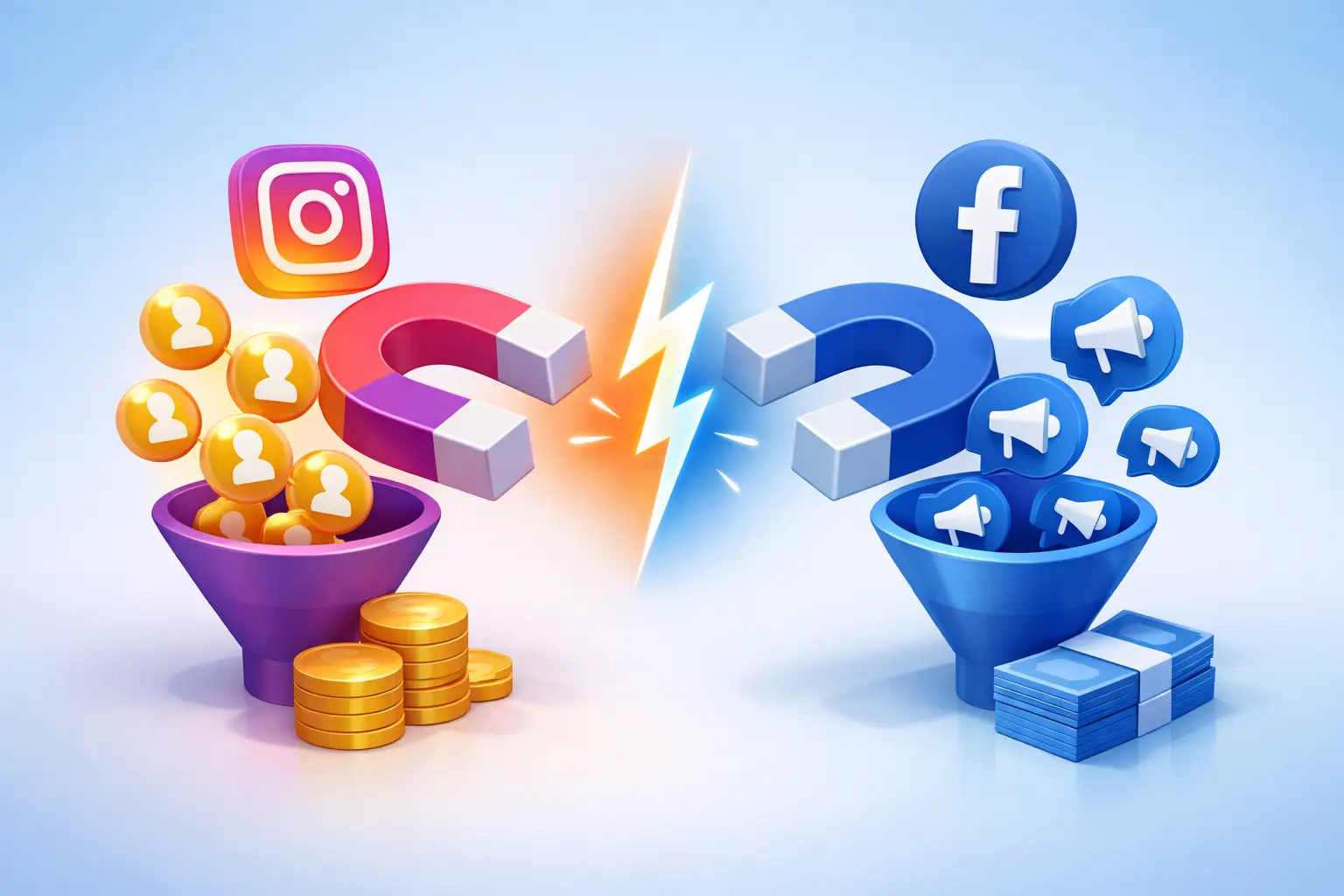
If your cost per lead keeps climbing and your ad account feels like a slot machine, this is the right comparison to make. Instagram leads versus Facebook ads is not just a channel choice. It is a decision about whether you want to rent attention from Meta or build a list of identifiable prospects you can contact directly.
For a lot of small businesses, agencies, consultants, and ecommerce brands, Facebook ads used to be the obvious move. You could launch fast, target hard, and scale with budget. That still works in some cases. But rising CPMs, audience fatigue, tracking gaps, and inconsistent lead quality have changed the math. Instagram lead generation, especially when it is based on extracting qualified public-profile prospects from specific audiences, offers a different kind of control.
Instagram leads versus Facebook ads: what changes in practice
The biggest difference is simple. Facebook ads are pay-to-play. You spend money to place a message in front of an audience and hope enough of them convert to justify the cost. Instagram leads, when sourced from relevant audiences, hashtags, locations, followers, likers, or commenters, give you a prospect database you can work repeatedly through outbound campaigns.
That means the asset is different. With Facebook ads, the ad spend stops and the flow usually stops with it. With Instagram lead generation, you keep the data, segment it, enrich it, and use it across email and retargeting workflows. One is rented distribution. The other is owned prospecting.
That distinction matters if your business needs predictable outreach instead of waiting for platform algorithms to cooperate.
When Facebook ads still make sense
Facebook ads are not dead. They are just less forgiving than they used to be.
If you already have a strong creative team, enough budget to test aggressively, and an offer with proven conversion rates, Facebook ads can still produce scale quickly. They are especially useful when your goal is broad reach, remarketing, or volume at the top of the funnel. Ecommerce brands with clear product-market fit can still use them effectively. So can businesses with compelling video, strong landing pages, and the patience to manage ongoing testing.
The trade-off is that Facebook ads demand constant optimization. Creative burns out. Audiences saturate. Lead forms often attract low-intent submissions. Performance can swing hard from one week to the next. If your margins are tight, that volatility hurts.
For smaller teams, this is where the frustration starts. You are not just buying leads. You are buying experimentation, creative production, and platform dependency.
Why Instagram leads appeal to growth-focused teams
Instagram is where people signal intent publicly. They follow competitors, engage with niche creators, comment on relevant content, and show up in location-based communities tied to real buying behavior. That creates a practical lead source if you know how to identify the right segments.
This is the advantage of Instagram leads. You are not guessing based only on broad demographic targeting. You are prospecting from visible behavior tied to your market.
A fitness coach can target people engaging with local gyms and wellness creators. A real estate professional can build lists from local business audiences and neighborhood hashtags. A B2B agency can identify followers of competitors or industry voices. An ecommerce brand can find users interacting with adjacent product niches. That kind of targeting is often sharper than what advertisers get through ad platform assumptions.
Once you have the right prospects, you can move fast. Instead of waiting for clicks and form fills, you can launch direct outreach and build custom audiences from that data. This shortens the path between finding interest and starting a sales conversation.
Cost comparison: rented clicks versus reusable lead data
Cost is where the argument usually gets settled.
Facebook ads can be profitable, but they have a built-in ceiling because every result requires ongoing spend. If your CAC rises and your conversion rate drops, there is no fallback. You keep paying or you stop generating opportunities.
Instagram leads work differently. The upfront effort goes into sourcing relevant audiences and organizing campaigns, but the output is reusable. You are building a lead engine, not just paying for traffic. That usually improves economics over time because one batch of qualified leads can support multiple contact attempts, offer angles, and retargeting workflows.
This does not mean Instagram leads are free. You still need the right tooling, messaging, and follow-up process. But the cost structure is usually more durable for businesses that need efficiency. If your team cares about reducing wasted spend and improving unit economics, direct lead sourcing often wins.
Lead quality: attention is not the same as intent
A click from a Facebook ad is not the same as a qualified prospect.
This is one of the most common mistakes in acquisition. Marketers see lead volume and assume pipeline quality. In reality, many ad-generated leads are cheap because the barrier to submit is low and the buyer intent is weak. You end up paying the sales team to sort through noise.
Instagram leads tend to be stronger when the source audience is chosen carefully. If someone follows a competitor, comments in your niche, or engages with content tied to your category, that signal can be more useful than a broad ad-platform interest bucket. It is not perfect, but it is often more commercially relevant.
The key phrase there is chosen carefully. Bad source selection creates bad lead lists. If you scrape generic audiences, your outreach will perform like generic advertising. Precision matters.
Speed to pipeline
If you need immediate visibility, Facebook ads can launch in a day. That is still their strength.
But speed to launch is not the same as speed to pipeline. Ads need approval, testing, optimization, and budget before they stabilize. If the funnel breaks at any step, you are spending before you learn.
Instagram lead workflows can move faster toward actual conversations. You identify a relevant audience, extract public prospects, segment them, and start outreach. For service businesses and agencies, that often means getting replies and meetings sooner than waiting for ad campaigns to mature.
This is why many operators now prefer outbound-supported acquisition. It gives them direct contact with people who already show niche relevance instead of relying on passive conversion behavior.
Instagram leads versus Facebook ads for different business types
For local businesses, Instagram leads are often the smarter play because location signals are visible and useful. You can prospect from local hashtags, nearby brands, events, and community accounts with much more precision than broad paid targeting.
For agencies and consultants, Instagram leads are typically better for proactive pipeline building. You do not need to wait for inbound. You can identify accounts already connected to your market and start conversations directly.
For ecommerce brands, the answer depends more. Facebook ads still have an edge for scaled product sales and remarketing. But Instagram lead sourcing can support partnerships, influencer outreach, wholesale prospecting, and customer acquisition in niche verticals.
For educators, coaches, and info businesses, Instagram leads can be extremely efficient because audience affinity is easy to spot. People already cluster around creators, themes, and specific content patterns.
The smartest approach is often both, but not equally
This is not always an either-or decision. The strongest setup for many businesses is to use Instagram lead generation as the core prospecting engine and Facebook ads as a support channel.
That means you build qualified lists first, run outbound campaigns to create direct conversations, and then use paid ads for retargeting, offer reinforcement, or follow-up visibility. In that model, ads stop being your only engine. They become an amplifier.
That is a healthier position. It lowers pressure on ad performance and gives you more ways to create revenue from the same audience.
Platforms like Mailerfind fit this shift because they make it practical to go from Instagram audience discovery to actual outreach without needing a complex stack or technical setup. That matters for lean teams that want control and speed.
Which one should you choose?
Choose Facebook ads if you have budget, proven creative, and a funnel that already converts. Choose Instagram leads if you want more control over targeting, lower acquisition waste, and a direct path to identifiable prospects.
If your business is tired of paying more for less certainty, the better question is not whether ads can still work. It is whether they should be your primary acquisition system. For many businesses now, the answer is no.
The strongest growth channels are the ones that let you find the right people, contact them directly, and measure revenue without guessing. Start there, and every dollar you spend afterward gets a lot smarter.